
What do you call a glut of Medlars? Our Head Gardener James suggested a “medley” which I quite like the sound of. Maybe the tree has now reached maturity or maybe it was the careful and thoughtful pruning we did last year (I will admit that there was a lot of standing around looking at the tree with the occasional bit of pruning but it is important to get the shape right), but it looks like we’ll have a bumper harvest of over 10 kilos this year!
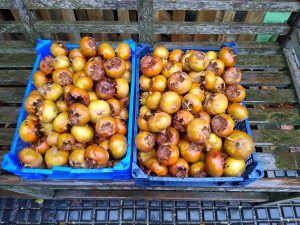
Due to its prime location of the corner of Goose Green near the Visitor Reception, we get lots of questions about this tree. What is it? What do you do with it? What does it taste like?
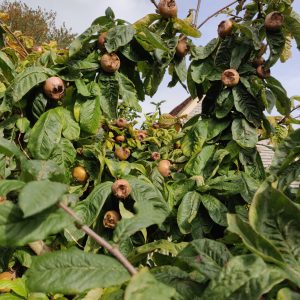
The Medlar (Mespilus germanica) is a small ornamental deciduous fruit tree which has been cultivated for over 3,000 years. Native to Iran, southwest Asia and south eastern Europe, it was brought to England by the Romans. The variety we have at Standen is called ‘Nottingham’ which has an Award of Garden Merit from the RHS. It bears large white flowers in May and the leaves turn a rusty orange colour in Autumn. The flowers are a good source of nectar for bees and beneficial insects and also attract moths and other night flying insects which in turn attract bats. Medlar trees are easy to grow, have good resistance to pests and diseases and are self fertile. They have a relatively short lifespan of 30 to 50 years.
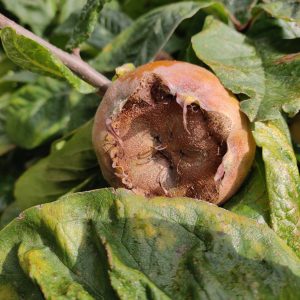
Once a popular fruit, it seems to have fallen out of fashion perhaps because it doesn’t look very appetising (in fact in Shakespeare’s time they were known as open arse fruit and the French call them cul de chien). They are high in Vitamin C and ready to eat when little other fresh fruit is available to harvest. The fruits are picked in November when still firm and a soft caramel colour and are left to ripen or ‘blet’ until they become dark brown, soft and wrinkled before they can be eaten or turned into jelly.
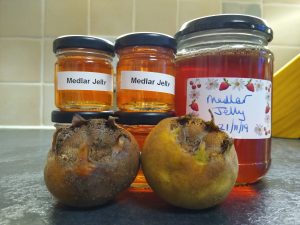
Medlars make a lovely bronze coloured jelly which is often referred to as fruity and aromatic or tasting like spiced apple. It can be served with cold roast meats and cheeses in place of redcurrant jelly or cranberry sauce. Jars of Medlar Jelly are currently available in the house and garden tea rooms for a donation to FOSE.
Medlar jelly
[Makes about two medium-sized jam jars]
Ingredients:
800g bletted medlars
200g firm medlars (this is important as Medlars are low in pectin but an apple can also be added.)
1.2 litres water
2 lemons
Sugar, about 2 to 3 cups
To blet medlars:
Place the firm unripe fruits on a shallow plate or tray. Don’t be tempted to pile them up or they may rot. Leave them at cool room temperature until they turn dark brown and soft.
Method:
Wash the fruit and remove any leaves. Depending on size, cut each fruit in half or quarters and place in a large saucepan. Pour over the water. Cut the lemon into six pieces and add to the fruit. Bring to the boil then turn the temperature down so that the liquid simmers gently. Partially cover with a lid and leave to cook for about an hour, taking care that the liquid doesn’t evaporate, and giving the fruit an occasional gentle squash with a wooden spoon. Avoid the temptation to stir or mash the fruit which will turn the jelly cloudy.
Pour the fruit and its liquid into a jelly bag suspended over a large jug or bowl. Let the juice drip into the jug until all the juice has dribbled through. Don’t be tempted to squeeze the jelly bag or the jelly may be cloudy.
Measure the amount of juice and put back into a clean saucepan. Boil for four minutes, then add an equal amount of sugar. When the sugar has dissolved bring to a rolling boil until set point is reached (about 130 oC), then pour into clean, warm jars and seal. Leave to cool.
Carolyn
